

“`html
The Case for Gatekeeping: Why Your Circle Should Be Hard to Join
In the modern era of radical inclusivity and “open-door” social policies, the word gatekeeping has become a dirty word. Usually associated with elitism or the exclusion of others from a hobby or community, gatekeeping is often viewed as a character flaw. However, when it comes to your personal life, your mental health, and your professional trajectory, gatekeeping is not just a right—it is a necessity.
The concept of “gatekeeping your circle” refers to the intentional curation of the people you allow into your inner sanctum. It is the realization that while you can be kind to everyone, you cannot be intimate with everyone. By making your inner circle hard to join, you aren’t being “mean”; you are being a steward of your own life. Here is why high-value individuals prioritize quality over quantity and why you should too.
1. The Reality of Finite Emotional Energy
Human beings have a biological limit on how many meaningful relationships they can maintain. Evolutionary psychologist Robin Dunbar famously proposed “Dunbar’s Number,” suggesting that humans can only maintain about 150 stable social relationships, with only 5 to 15 occupying the “inner circle” of deep trust and frequent interaction.
Every person you let into your inner circle requires a “subscription” of your time, emotional labor, and mental bandwidth. When you leave the gates wide open, you end up spread too thin. You become a “mile wide and an inch deep,” unable to provide the necessary support to those who truly matter because you are exhausted by the demands of casual acquaintances and “energy vampires.” Gatekeeping ensures that your best energy is reserved for those who have earned it.
2. The Law of Averages: You Are Who You Surround Yourself With
The famous adage by Jim Rohn states: “You are the average of the five people you spend the most time with.” This isn’t just a motivational cliché; it’s a psychological reality. Our peers influence our language, our work ethic, our health habits, and—most importantly—our perception of what is possible.
- Ambition Contagion: If your circle consists of high-achievers, their “normal” becomes your “baseline.”
- Mindset Mirroring: Surrounding yourself with chronic complainers will eventually tint your worldview with negativity.
- Risk Tolerance: When your friends are entrepreneurs or calculated risk-takers, you are more likely to pursue your own dreams.
If you don’t gatekeep your circle, you leave your personal growth to chance. By setting a high bar for entry, you ensure that the “average” of your circle pulls you upward rather than dragging you down.
3. Protecting Your Psychological Safety
Your inner circle should be a sanctuary—a “no-judgment zone” where you can be vulnerable, admit failure, and seek genuine counsel. When you allow people into this space without a vetting process, you risk introducing toxicity, gossip, and judgment into your safe haven.
Gatekeeping acts as a security system for your peace of mind. A hard-to-join circle is built on proven loyalty and shared values. It takes time to see how someone reacts when you succeed (are they truly happy for you?) and how they react when you fail (are they there to pick you up?). Without a “probationary period” for new friends, you risk giving your heart to people who haven’t shown they know how to handle it with care.
4. The Distinction Between “Kindness” and “Access”
One of the biggest hurdles to effective gatekeeping is the guilt associated with saying “no.” Many people confuse being a “good person” with being “accessible.”
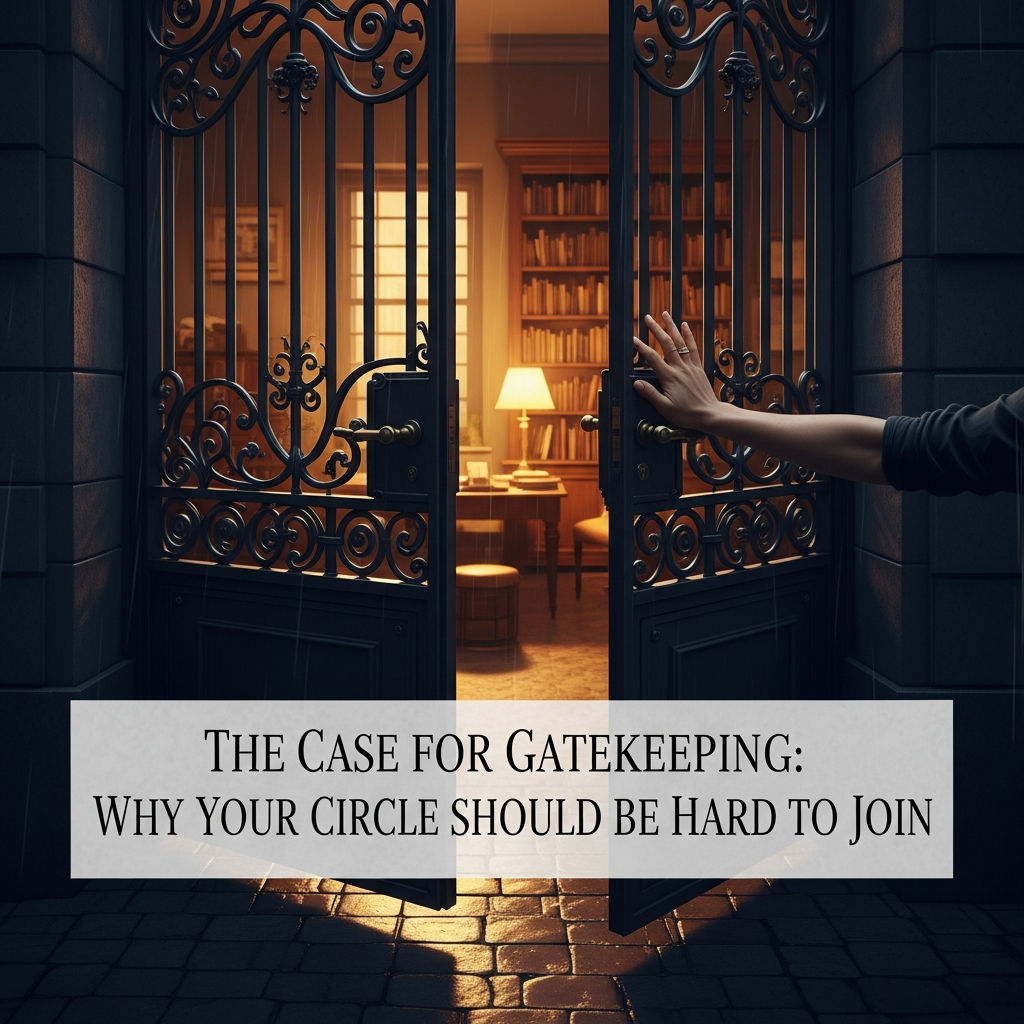
You can be a kind, empathetic, and helpful person to the world at large while still maintaining a very small, exclusive inner circle. Access to your private thoughts, your home, and your free time is a privilege, not a right. When you make your circle hard to join, you communicate self-respect. People who respect themselves naturally attract others who value their own time and boundaries.
5. Weed Out the “Transactional” Relationships
As you become more successful—whether financially, socially, or professionally—you will inevitably attract people who want to be near you for what you have rather than who you are. These transactional relationships are the silent killers of genuine fulfillment.
Gatekeeping allows you to vet people’s intentions. By not instantly granting “best friend” status to every new acquaintance, you give yourself the space to observe. Does this person only call when they need a favor? Do they only show up when things are going well? A high barrier to entry filters out the opportunists and leaves you with the “ride-or-die” companions who value your essence over your assets.
6. How to Gatekeep Your Circle Gracefully
Gatekeeping doesn’t mean being rude or standoffish. It means being intentionally slow. Here is how to implement a vetting process for your social life:
- The Observation Phase: Meet new people in “low-stakes” environments (coffee, group events) several times before inviting them into your private spaces.
- Shared Value Alignment: Pay attention to how they treat service staff, how they speak about their other friends, and how they handle conflict. If their values don’t align with yours, they stay in the “acquaintance” category.
- Listen to Your Intuition: If you feel drained after spending time with someone, that is a data point. Listen to it.
- Establish Boundaries: Protect your time. You don’t have to respond to every text immediately or say yes to every Friday night invite.
7. The ROI of an Exclusive Circle
The “Return on Investment” of a curated circle is immense. When you are surrounded by a few high-quality individuals, your life becomes simpler and more potent. You experience less social drama, more focused professional collaboration, and deeper emotional intimacy.
A gatekept circle creates a “Mastermind” effect. Whether you are discussing business, parenting, or personal philosophy, the quality of the conversation is elevated because everyone at the table has earned their seat. This exclusivity breeds a level of trust that allows for radical honesty, which is the only way we truly grow.
Conclusion: Your Life, Your Gates
We gatekeep our homes with locks, our bank accounts with passwords, and our phones with biometrics. It is illogical to leave the most influential part of our lives—our social environment—wide open to whoever happens to wander in.
Being “hard to join” isn’t about being better than others; it’s about being protective of the only life you have. When you raise the standards for your inner circle, you don’t just change who you spend time with—you change who you are becoming. Stop apologizing for your gates, and start making sure only the right people have the keys.
“`